Foods to Avoid in Pregnancy (and Why, Specifically)
Most 'foods to avoid' lists just list the foods. Here's the actual reasoning behind each one, so you know what genuinely matters and what's more about caution than real risk.
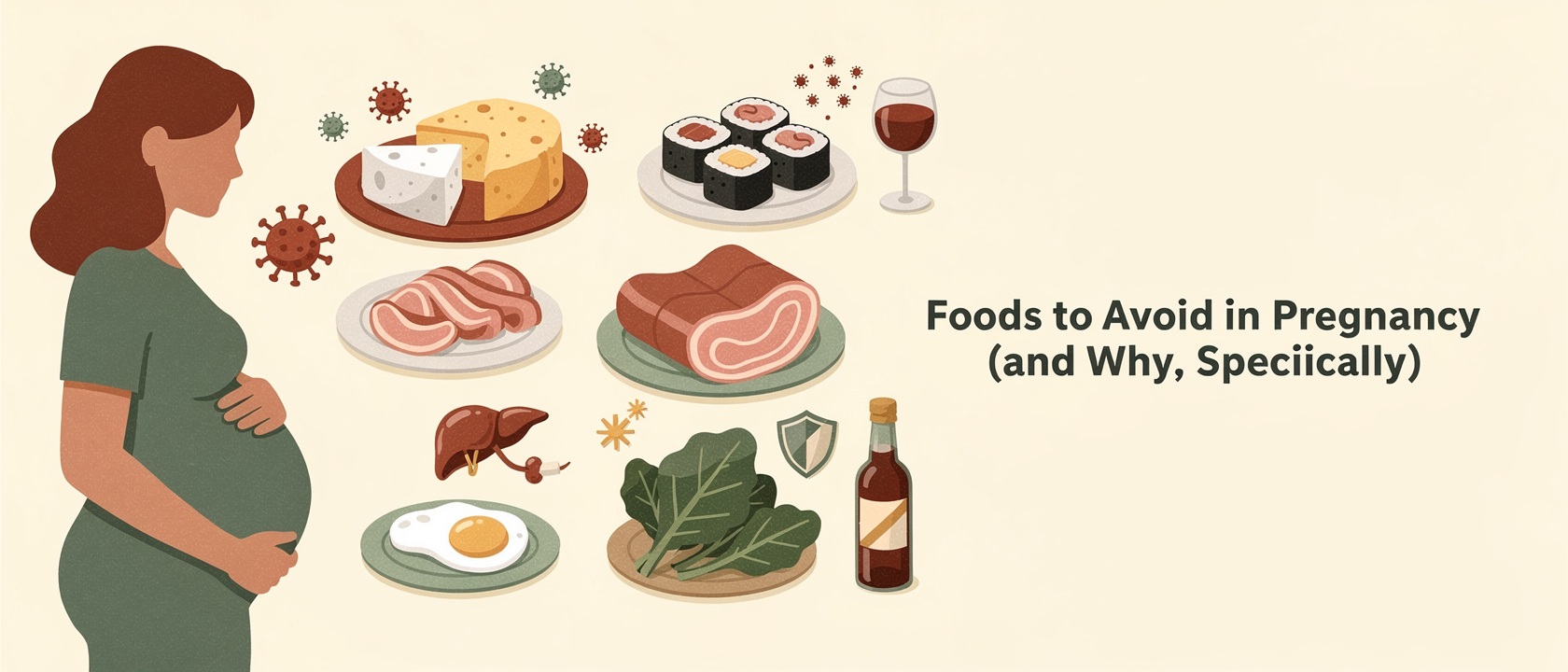
Pregnancy food-avoidance lists tend to just list items without explaining why, which makes them hard to apply sensibly to situations not explicitly on the list. Here's the actual reasoning behind each category, grouped by the specific risk involved.
Listeria risk: unpasteurised and certain soft cheeses
Listeria bacteria can cross the placenta and, while rare, can cause serious complications including miscarriage or stillbirth. This is why the NHS advises avoiding: unpasteurised milk and dairy, mould-ripened soft cheeses (brie, camembert, chèvre) and soft blue cheeses, unless cooked thoroughly until steaming hot throughout. Hard cheeses (cheddar, parmesan) and hard blue cheeses are fine, since listeria struggles to survive in their lower moisture content.
Listeria and other bacteria: pâté and cold cured meats
All types of pâté (including vegetable pâté) are advised against due to listeria risk. Cold cured meats (salami, chorizo, prosciutto) can carry toxoplasmosis-causing parasites, and the NHS advises either avoiding them or freezing them for four days first, which kills most parasites present.
Toxoplasmosis and salmonella: raw or undercooked meat, and raw eggs
Undercooked meat can carry toxoplasma, a parasite that can cause serious problems for the baby if a first-time infection happens during pregnancy. Cook meat thoroughly until there's no pink meat and juices run clear. Raw or partially cooked eggs (unless "British Lion" stamped, which are considered lower salmonella risk) carry a salmonella risk — runny yolks from non-Lion-stamped eggs are best avoided.
Vitamin A: liver and high-dose supplements
Liver and liver products (pâté included, again) are very high in vitamin A, and excess vitamin A in pregnancy is linked to birth defects. This is a specific, evidenced concern — not general caution — which is why liver is singled out even though it's otherwise a nutritious food. Avoid supplements containing vitamin A/retinol unless specifically advised by a GP.
Mercury: certain fish
Mercury accumulates in some larger, longer-living fish and can affect a developing nervous system. The NHS advises avoiding shark, swordfish and marlin entirely, and limiting tuna to no more than 2 steaks or 4 medium cans a week, since mercury builds up with total consumption over time, not from a single portion.
Caffeine: limit, don't eliminate
The NHS advises limiting caffeine to under 200mg a day in pregnancy (roughly one mug of instant coffee, or two mugs of tea) — total elimination isn't required, but higher intake is linked to lower birth weight and other risks. Remember caffeine also hides in cola, energy drinks, and chocolate, not just coffee and tea.
Alcohol
The NHS advises the safest approach is not to drink any alcohol at all during pregnancy, since no amount has been proven completely safe, and risk increases with the amount consumed.
Mentioned in this guide
Frequently asked questions
Can I eat sushi while pregnant?+
Sushi made with previously frozen fish is generally considered fine, since freezing kills most parasites of concern. Fresh, never-frozen raw fish carries a small parasite risk, so it's worth checking with the restaurant or sticking to cooked options if you're unsure.
Is peanut butter safe in pregnancy?+
Yes — current NHS guidance no longer advises avoiding peanuts in pregnancy unless you have a known allergy yourself. Earlier advice to avoid peanuts has since been revised based on updated evidence.
What if I ate something on the avoid list before I knew the rules?+
A single instance is very unlikely to cause a problem — these are guidelines to reduce risk over the whole pregnancy, not a single-exposure danger threshold. If you're worried about a specific instance, mention it to your midwife or GP for reassurance.
Sources

Written by
Sepehr
Software engineer, soon-to-be dad, uncle to four — the tech-obsessed half of the two of us testing this stuff. Currently building this site with my wife, ahead of our own baby arriving.